
AI Ski Technique Analysis
Table of Contents
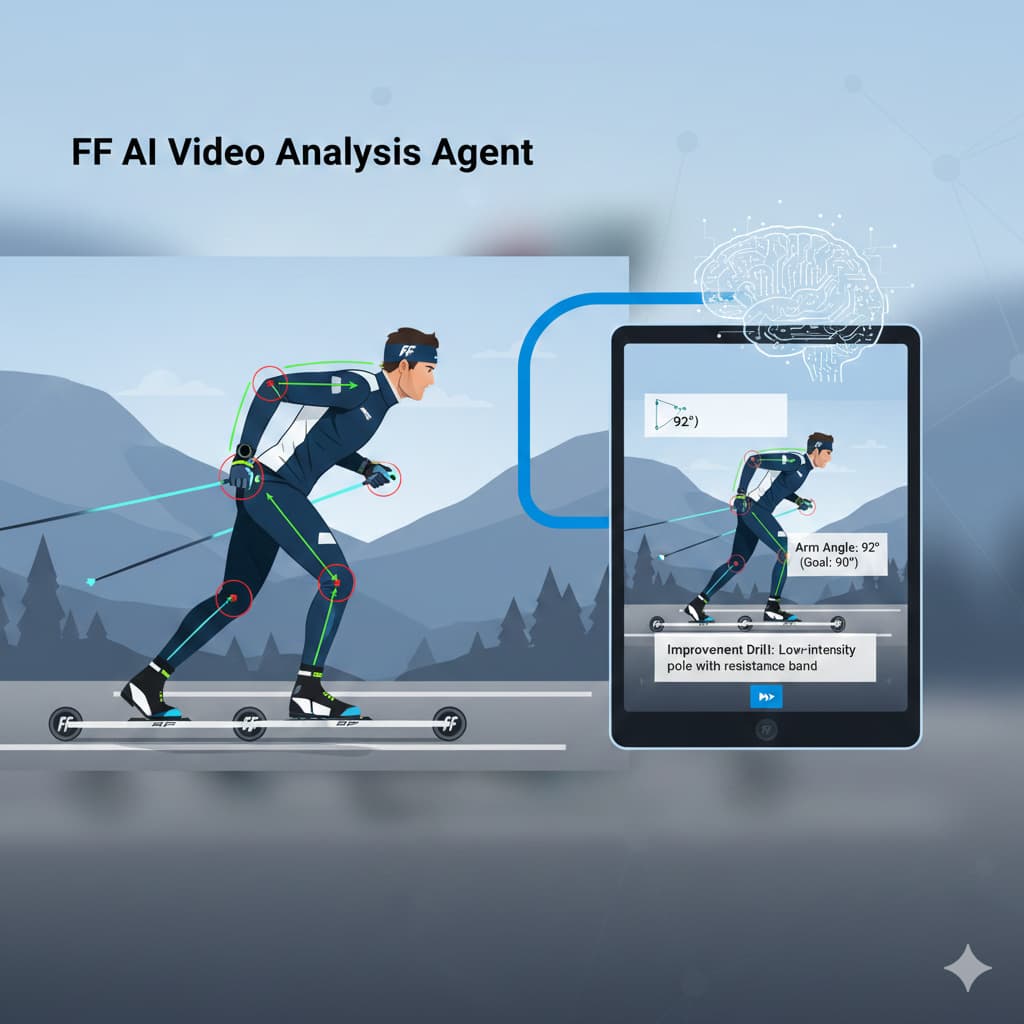
FF Rollerskis’ AI ski technique video analysis tool delivers objective, frame-by-frame biomechanical feedback on your cross-country skiing or rollerskiing technique — all within 60 seconds of uploading your video. Developed by FIS-approved Norwegian rollerski manufacturer FF Rollerskis AS in collaboration with certified Nordic coaches, this tool gives international coaches and athletes access to the same data-driven technique review used at World Cup level.
Why Coaches Worldwide Choose FF AI Video Analysis
- 60-Second Turnaround: Upload from your mobile, GoPro, or drone and receive a complete annotated report in under 60 seconds — no software to install, no manual frame scrubbing.
- Objective Biomechanical Data: Eliminate guesswork. Get precise joint angles, push-off timing, balance scores, and asymmetry measurements presented with clear visual markers directly on the video.
- Technique-Specific AI Models: The AI applies dedicated biomechanical models for each technique — classic diagonal stride, double poling, and V1/V2/V2-alt skating — not a generic sports analysis engine.
- Personalised Corrective Drills: Every report includes specific exercises tailored to each athlete’s detected movement faults, ready to forward directly to the athlete.
- World Cup Benchmark Comparison: See your athlete’s joint positions side-by-side with elite FIS World Cup data, so improvement targets are always concrete and measurable.
“This tool saves me 70–80% of the time I used to spend on video analysis. Now all my athletes get top-tier follow-up every week.” — Club coach, Central Europe
What Does AI Ski Technique Video Analysis Actually Measure?
Our AI ski technique video analysis uses computer vision trained specifically on Nordic skiing and rollerskiing biomechanics. It is not a generic sports AI — every measurement is calibrated against norms derived from elite FIS competition data. Here is what each technique module detects:
Classic Diagonal Stride Analysis
This AI ski technique video analysis measures kick timing relative to the body’s centre of mass, pole plant angle, arm swing amplitude, and hip extension at push-off. Common faults detected include early weight transfer, insufficient kick, and insufficient hip drive. Each fault is annotated directly on the video with frame-by-frame precision.
Sample AI output – Classic Diagonal: Kick phase initiates 0.08 s early relative to optimal centre-of-mass position. Hip extension at push-off reaches 168° (target: 175–180°). Left arm pull terminates 12° short of full range. Recommended drill: Single-leg balance kick with pole tap.
Double Poling Analysis
Double poling is the most power-dependent technique in cross-country skiing. The AI ski technique video analysis evaluates pole plant angle (optimal: 75–80° from horizontal at contact), elbow position through the compression phase, trunk rotation, and finish position. Wrist and elbow angles are measured frame by frame. Athletes who plant the pole too late or shorten the pull see this quantified immediately rather than described verbally.
Sample AI output – Double Poling: Pole plant angle: 71° (target 75–80°). Compression phase duration: 0.31 s (slightly short). Trunk angle at compression: 42° (target 40–45°). Core engagement score: 7.2/10. Main improvement opportunity: plant the pole 0.05 s earlier and 4° more vertical.
Skating Technique Analysis (V1, V2, V2 Alternate)
Skating on rollerskis involves complex asymmetric coordination. The AI ski technique video analysis engine analyses push angle, glide duration per stride, arm-leg synchronisation, and lateral balance. A common finding in recreational skaters is asymmetric push — one side generating 15–25% more force than the other, causing energy waste and cumulative knee stress. The AI flags and quantifies this asymmetry in the report.
Sample AI output – V2 Skating: Right push duration: 0.41 s, Left push duration: 0.35 s (asymmetry: 17%). Right arm pole plant 0.04 s late. Glide phase balance score: 6.4/10 (target: 8+). Recommended drill: 30-second single-skate glide balance drill, focusing on left-side extension.
Built to Augment — Not Replace — the Human Coach
The FF AI ski technique video analysis agent is designed to augment human coaching, not replace it. All AI output is presented as objective data: angles, timing, and asymmetry scores. Interpretation, training load management, motivational context, and injury risk assessment remain the domain of the human coach.
Our recommended AI ski technique video analysis workflow: the AI runs the technical measurement and generates the annotated video report. The coach reviews the flagged issues, selects the two or three highest-priority corrections for the athlete’s current training phase, and adds personalised context before sending the report to the athlete. This takes 5–10 minutes per athlete instead of 45–90 minutes of manual frame-by-frame review.
Every AI ski technique video analysis recommendation is based on biomechanical norms derived from elite Nordic skiing data. Coaches with advanced training may choose to apply different standards for developing athletes — the AI reports are always advisory, and the coaching relationship and judgment always prevail.
Camera Setup Guide for Best Analysis Results
To get maximum accuracy from your AI ski technique video analysis report, follow these camera placement guidelines.
- Side view: Best for most technique analyses — place camera 5–8 metres away at hip height. Capture at least 4–6 full strides.
- Front view: Ideal for detecting asymmetry and lateral balance. Stand 10 metres ahead of the direction of travel.
- Drone / overhead view: Best for double poling rhythm and pole symmetry. Requires drone at 8–12 metres altitude, hovering directly overhead.
Video length: 60–120 seconds is optimal. Shorter clips may not capture enough strides for statistical reliability. Longer clips are acceptable but may increase processing time. Film at 1080p / 60 fps for best joint-landmark detection accuracy.
Lighting Conditions for Reliable AI Analysis
Natural daylight consistently produces the best results for AI ski technique video analysis. Overcast conditions are ideal — they eliminate harsh shadows that can obscure joint positions and disrupt landmark tracking. If filming indoors on a ski ergometer or treadmill, use at least 1000 lux of diffused overhead lighting directed toward the skier rather than the camera. Avoid backlit scenarios where the skier appears as a silhouette against a bright window or snow-covered background. High-contrast clothing — such as a dark top with light leggings, or a full-colour training suit — helps the AI engine distinguish body segments accurately and improves skeleton overlay precision.
Preparing Athletes for Video Capture
For the most representative AI ski technique video analysis output, capture technique in a realistic training or race context rather than a reduced-effort demonstration. Athletes often slightly alter mechanics when asked to perform a “show” stroke; natural competition-intensity movement gives biomechanical scores that reflect actual training state. A short 3–5 minute warm-up before capture ensures joint mobility is representative. Record at least five complete technique cycles per submission to give the algorithm enough data for statistically reliable scoring. Label each clip clearly before upload — technique type, date, athlete name, and surface condition (snow, tarmac, roller) — so report archives remain searchable over a full season.
About FF Rollerskis — FIS-Approved Nordic Equipment Manufacturer
FF Rollerskis AS is a Norwegian manufacturer of FIS-approved rollerskis, supplying equipment to FIS World Cup events for six consecutive seasons. This AI ski technique video analysis service was developed in-house and validated against FIS World Cup biomechanical data in collaboration with certified Nordic coaches. Our international coaching tools are available globally at ffskis.com, while our Norwegian product range and Norwegian-language coaching services are available at ffskis.no.
How to Interpret Your AI Ski Technique Video Analysis Report
After uploading your skiing clip, the AI ski technique video analysis report delivers a structured breakdown across three layers: biomechanical scores, fault detection flags, and personalised drill recommendations. Understanding each layer helps you and your coach turn data into on-snow improvements faster.
Biomechanical Score Overview
Each technique receives a composite score from 0–100 based on joint alignment, tempo consistency, and force-application timing. A score above 75 indicates competition-ready mechanics; scores between 50–74 suggest targeted drills; scores below 50 indicate foundational work is needed. The AI ski technique video analysis engine calibrates these benchmarks against anonymised data from FIS-level athletes, giving your score real-world context regardless of your current training level.
Fault Detection Flags
The fault detection module identifies up to 12 common technical errors per technique, including late pole plant timing, asymmetric kick extension, and insufficient hip drive. Each flag includes a timestamp so you and your coach can replay the exact moment in the original footage. Because faults are ranked by performance impact, you always know which fix delivers the biggest efficiency gain — a key advantage of AI ski technique video analysis over subjective manual review.
Personalised Drill Recommendations
Every report closes with three to five prioritised drills matched to your specific fault profile. Drills link to video demonstrations hosted on ffskis.com, so athletes can self-correct between coaching sessions. Coaches can export the full AI ski technique video analysis report as a PDF to share with athletes or include in periodisation plans. After completing the recommended drills, re-uploading a new clip within the same training block allows progress tracking across multiple sessions.
Frequently Asked Questions
What ski techniques can the AI analyse?
The AI ski technique video analysis covers classic double poling, skating / freestyle (V1, V2, V2 alternate), and classic diagonal stride. You select the technique when uploading so the correct biomechanical model is applied.
How long does the AI ski analysis take?
Most AI ski technique video analysis reports are delivered within 60 seconds of upload. Complex or longer videos may take up to 5 minutes. You will receive the report by email as soon as it is ready.
What video formats and file sizes are accepted?
MP4, MOV, and WebM formats are accepted for AI ski technique video analysis. Maximum file size is 150 MB. For best results, film at 1080p / 60 fps. GoPro footage from a side-mounted position on a companion skier works well.
Can I use drone footage for the analysis?
Yes. Drone footage requires at least 4K resolution for accurate joint-landmark detection. Position the drone 8–12 metres above the skier, directly overhead, for double poling rhythm and pole symmetry analysis.
Is the AI ski analysis GDPR-compliant?
Yes. Uploaded videos are processed securely and deleted from our servers within 30 days. We do not store personal data beyond what is necessary for delivering the analysis report. Full details are in our Privacy Policy.
Do I need ski coaching experience to use the AI analysis?
No prior coaching experience is required. The AI ski technique video analysis platform is designed for self-coached athletes, recreational skiers, club coaches, and national-level performance directors alike. The report uses plain-language explanations alongside technical metrics, so any user can immediately understand the findings and apply the recommended drills. Athletes training independently find the tool especially valuable for getting objective feedback without coach access during off-season or travel periods.
What camera angle works best for AI ski analysis?
For the most accurate AI ski technique video analysis, film from a lateral (side-on) position at hip height, keeping the full body within frame throughout the movement cycle. For double poling and diagonal stride, a 45-degree rear-lateral angle also produces reliable results. Avoid overhead or head-on angles for primary capture — these can reduce joint-landmark detection accuracy. A tripod or stable pole mount gives the clearest frame-by-frame data, though handheld footage at 60fps or above is also accepted. Most smartphone cameras on standard “video” mode with good natural light deliver sufficient resolution for high-quality analysis.
Can I compare multiple AI ski analysis reports over time?
Yes. The AI ski technique video analysis platform stores your previous reports in your dashboard, allowing direct side-by-side score comparison across sessions. Progress trend graphs show biomechanical score changes by technique category over your training block, making it easy to quantify improvement and communicate development to athletes, club committees, or national federation staff. Many coaches upload comparison clips at the start and end of a training camp to measure the direct impact of technical coaching on objective biomechanical scores.
How is the ffskis.com AI coach different from ffskis.no?
ffskis.com is FF Rollerskis’ international AI ski technique video analysis platform, serving coaches and athletes worldwide in English. ffskis.no is our Norwegian-language platform focused on the Norwegian market, offering local purchasing, Norwegian coaching content, and NOK pricing. The AI analysis tool available here on ffskis.com is designed for the international coaching community.